
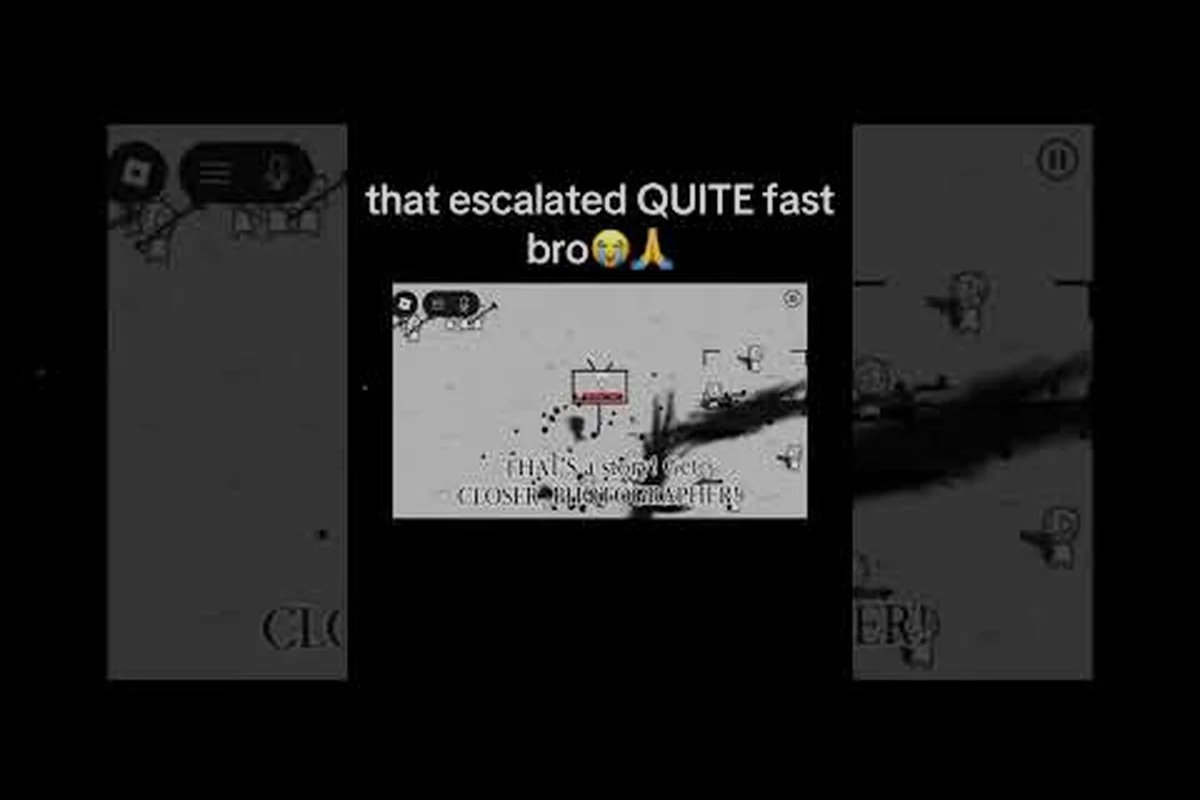
Roblox games with choices matter because a decision can alter the story, characters, or outcome instead of serving as decoration. Learn how to spot meaningful branches and judge Say Cheese! through focused, controlled tests.
What Choice-Driven Means on Roblox
A choice-driven Roblox game gives the player a decision that meaningfully changes what happens afterward. That change may affect the route through the experience, the information revealed, another character’s response, or the result of the story. The key word is meaningfully: a choice that only changes the selected button, dialogue line, or animation is not necessarily a branch.
The official Roblox page for Say Cheese! describes the player as a journalist hired by Big Media and sent into a park to spread chaos and panic while billions watch the latest news. Its premise also frames a binary decision: destroy the peaceful society or change fate and bring hope to everyone. That makes the experience relevant to anyone comparing Roblox games with choices because the creator clearly presents the player’s decision as part of the story.
The page classifies Say Cheese! as Adventure / Story with a Minimal maturity label. It also says the game is based on We Become What We Behold, the browser game by Nicky Case, but that connection should be treated only as thematic inspiration. The original game’s structure and behavior cannot be used to infer how Say Cheese! handles a specific decision.
| Element | Official description | What it suggests for choice design |
|---|---|---|
| Player role | A journalist working for Big Media | The player acts inside a media system rather than observing it from outside |
| Setting | A park where chaos and panic are to be spread | Public reactions may be central to the decision loop |
| Central tension | Destroying peaceful society or changing fate to bring hope | The framing explicitly contrasts destructive and hopeful directions |
| Outcome disclosure | The creator leaves the final choice with the player | Consequences are intended to be discovered through play rather than listed in advance |
A useful way to understand choice-driven design is to separate three layers. The input layer is the decision itself, the state layer records what the player selected, and the consequence layer changes later behavior or presentation. A real branch must connect all three. A cosmetic choice stops at the input layer, while a lightly consequential branch may update a small piece of state without producing a meaningful narrative difference.
That framework matters for Roblox games with choices because many experiences use dialogue menus to make players feel involved. Participation is not the same as agency. The strongest examples make the player responsible for a decision, reveal the effects of that decision, and preserve enough contrast between outcomes to make the result feel attributable to the player rather than to chance.
Choice, agency, and consequence
Choice is the visible act of selecting one option. Agency is the player’s ability to understand that selection and believe it matters. Consequence is what the game does with the selection afterward. These ideas overlap, but separating them helps during evaluation.
For Say Cheese!, the official description gives the player a role with an explicit objective and frames a morally divided objective. That supports a high-level claim that the game is built around a consequential decision. It does not, by itself, prove how many distinct responses exist or exactly which elements change after each selection. Those details are not documented on the official page, so check in game.
Community videos (as of 2026-10-31) discuss multiple endings; the creator has not published a list, a count or any ending names, so treat them as unconfirmed. Because of that limitation, the fairest evaluation method is a controlled playthrough rather than trusting a community label or assuming that every visible selection creates a dramatically different conclusion.
Real Branches Versus Cosmetic Choices
A real branch has a traceable effect that the player can identify. A cosmetic choice changes the presentation without changing the underlying outcome. The distinction is not simply visual versus nonvisual; some branches change only one line of dialogue, while others change the entire sequence. The better test is whether the difference is intentional, stable, and meaningful within the game’s own narrative logic.
Start by asking whether the choice changes what happens, what the player knows, how the world responds, or which objective the player can pursue. If it changes none of these, the menu may be flavor text rather than a branch. If it changes one of them, note the exact difference instead of assigning an importance label before completing the run.
| Type | What changes | Test |
|---|---|---|
| Cosmetic choice | Wording, appearance, or a short reaction | Compare two runs and look for any later story or gameplay difference |
| State record | The game remembers the selected option | Verify whether that memory changes a later interaction |
| Consequence branch | Events, dialogue, objectives, or the ending differ | Complete one controlled run for each option |
| Route branch | Players proceed through different sequences | Compare the route after choices while ignoring unrelated timing |
| False branch | The choice appears available but reconverges immediately | Check whether meaningful state survives beyond the selection scene |
A practical way to test a branch is to write down three items immediately after each decision: the selected option, the immediate response, and the first later event that differs from the previous run. This creates a consequence ledger without relying on spoilers or community assumptions. It also prevents the common mistake of treating an unfamiliar animation as a meaningful structural change.
For Say Cheese!, the documented scenario makes the test especially relevant. Because the player is framed as a journalist spreading panic for a mass audience, a decision might influence the depicted public response, the direction of the story, or both. However, the exact mapping is not documented, so players should record what they observe rather than predict the result from the premise.
This distinction also explains why comparing Roblox games with choices requires more than reading a description. A description can promise moral weight, but it cannot reveal whether every later scene responds to the player’s input. The official page establishes intent; controlled play establishes implementation.
A fair comparison standard
A fair comparison uses the same standard for every candidate. Give each important option one complete run, record major differences, and avoid judging by spectacle alone. A dramatic cutscene may be less meaningful if it converges back to the same route, while a modest change in dialogue may be more meaningful if it permanently redirects the player’s responsibility. Keep the evaluation focused on four signals:
-
Persistence: Does the selected option remain relevant later?
-
Contradiction: Do the two runs visibly diverge?
-
Responsiveness: Does the game acknowledge the specific choice?
-
Completion effect: Does the outcome differ, even if the broad theme remains the same?
The completion effect deserves special attention because some narrative games reserve major differences for the conclusion. A run may feel similar for most of its duration and still deliver a meaningfully different result. Conversely, several menus that alter the journey can still finish with the same outcome if the game deliberately uses choices for texture rather than branching. For broader genre comparisons, the best Roblox story games overview can provide a separate list to evaluate, but its titles should be judged on their own pages rather than assumed to use the same mechanics.
How to Test a Choice System
Testing a choice system should be controlled enough that differences are attributable to the selected option. That means changing one decision at a time, recording the same checkpoints, and completing the route before drawing conclusions. Random interruptions, unrelated exploration, and shifting expectations can make strong choices look cosmetic.
Use a fresh run when practical. Note the decision, avoid changing any other major route immediately afterward, and capture three checkpoints: the immediate scene, the next major interaction, and the conclusion. If the official page does not document an outcome name, use neutral labels such as Option A and Option B.
A repeatable test protocol
| Step | Action | Signal |
|---|---|---|
| 1 | Read the choice before selecting | The option states an intention, target, or value |
| 2 | Record the exact selection | You can compare identical decision points later |
| 3 | Note the immediate response | The game acknowledges the action in some way |
| 4 | Reach the next major interaction | A difference appears, or the routes clearly reconverge |
| 5 | Continue to completion | The full result reflects the decision or does not |
| 6 | Repeat with another option | Any meaningful divergence becomes easier to identify |
The most useful protocol is one controlled run per option. It sounds basic, but it prevents a common evaluation error: observing different scenes and assuming the choice caused them. If two runs differ in timing, exploration, or unrelated interactions, the evidence is weak. Repeating only the decision point under similar conditions produces a cleaner comparison.
Players can also record whether the choice changed information. Did the game reveal something it had withheld? Did another character react differently? Did the player’s objective become more or less aligned with the original assignment? These questions are especially valuable when evaluating Roblox psychological games, where the emotional or moral effect may matter even when the basic objective stays similar.
| Evidence | Strong branch signal | Weak branch signal |
|---|---|---|
| Dialogue | A response directly addresses the selection | Generic praise or criticism appears |
| Scene order | A later scene appears in a different order | Only the selection screen differs |
| Objective | The next task reflects the decision | The task is unchanged in every respect |
| Character response | Behavior or tone changes in a specific way | The same generic reaction occurs |
| Conclusion | The result reflects the route taken | The conclusion is identical despite the choice |
Do not fill gaps with assumptions. If you cannot determine why a response changed, mark the result as unclear and observe it again. Unclear causality is useful data; it shows that the game did not communicate a strong enough connection between decision and consequence.
For Say Cheese!, the official media premise gives players a clear way to phrase observations. A journalist’s responsibility to Big Media, the park setting, and the stated hope-versus-destruction framing can serve as comparison points. The exact branching structure remains undocumented, so check in game rather than assuming which scene belongs to which choice.
Design Trade-offs Developers Face
Choice systems force developers to balance replay value, production cost, clarity, and narrative coherence. More options can make players feel responsible, but each consequential route demands additional writing, testing, and visual support. Too few changes make the menu feel decorative; too many abrupt changes can make the story feel fragmented.
The clearest trade-off is between authorial control and player responsibility. A tightly controlled route protects theme and pacing, while a flexible route makes the player’s selection more consequential. Good choice-driven games often use a middle path: the world may have a planned structure, but the player still influences what happens within it.
| Trade-off | Benefit | Cost |
|---|---|---|
| More distinct outcomes | Replay value and stronger player ownership | Greater writing, production, and testing demands |
| Fewer distinct outcomes | Tighter pacing and easier consistency | Risk of making decisions feel cosmetic |
| Immediate feedback | Players understand that an input mattered | Can interrupt the story or disclose consequences too early |
| Delayed feedback | Preserves mystery and emotional weight | Can make branching feel arbitrary if cues are weak |
| Clear cause and effect | Builds trust in the choice system | Reveals the design pattern sooner |
| Subtle differentiation | Encourages multiple playthroughs | Risks being mistaken for no consequence |
These trade-offs also shape how Roblox games about media can operate. Media narratives often revolve around attention, framing, and public reaction. A choice system can reproduce that theme by making the player’s treatment of a situation affect how the depicted audience responds. That does not prove Say Cheese! uses every possible technique associated with the genre, but it explains why its documented premise makes player responsibility a sensible focus.
Production limits change the form of a branch
A branch does not always require a separately produced sequence. It might be a changed objective, an altered piece of information, or a different final exchange. Those lighter forms can preserve the feeling of consequence without multiplying the entire production budget.
There is also a distinction between content variation and state variation. Content variation supplies a different scene, while state variation changes what the player can do or know inside a shared scene. Both count when the change is intentional and clear. Neither should be dismissed merely because it is subtle.
Say Cheese! launched on October 19, 2026, and the public snapshot dated 2026-10-31 shows rapid attention: 3,955,237 visits, 13,403 players, 49,747 favorites, and 12,154 likes against 1,369 dislikes, or about 90% positive. The creator group had 4,810 members. These are platform-level snapshots, not permanent totals, but they suggest that many Roblox games with choices are being evaluated while interest is still high.
For Roblox games about news or social media, the same production question becomes thematic: when does a simulated audience make one choice consequential? If the audience reacts differently, the media spectacle has consequences. If every decision produces the same public mood and route, the premise may remain thematically strong while the interaction system stays largely cosmetic.
Judging Say Cheese! Among Choice Games
The strongest basis for judging Say Cheese! is the combination of its explicit choice premise and what a controlled run reveals. The official page clearly establishes a player role, a public setting, a media audience, and a destructive-versus-hopeful framing. It also states that the player is “on camera,” reinforcing that exposure and attention are central to the concept.
Its public reception was strong in the October 31, 2026 snapshot, but popularity is not the same as branching depth. The page showed about 90% positive ratings, yet ratings communicate satisfaction rather than the structural difference between choices. To judge the game among Roblox games with choices, you need route evidence from play.
| Evaluation factor | Strong result | Limited result |
|---|---|---|
| Choice clarity | The player can describe what each option means | The options feel vague or interchangeable |
| Cause and effect | Later events clearly respond to the selection | Choices do not influence the route |
| Narrative consistency | Each response fits the journalist premise | Branches feel unrelated to the central theme |
| Emotional impact | The outcome reflects the player’s responsibility | The result appears detached from the choice |
| Replay motivation | Another run offers a meaningful contrast | A second run feels largely redundant |
Apply the same questions to other Roblox satire games, Roblox games about news, and Roblox psychological games: Does the decision change the story, does the game communicate responsibility, and does the outcome preserve thematic coherence? Comparing only menus, thumbnails, or popularity can identify candidates, but it cannot establish meaningful choice design.
The creator’s limited official presence also deserves context. Mechanical Boy LLC's group page on Roblox listed one public experience and 4,810 members as of 2026-10-31. Because no broader official channel is documented, the game page and direct play should remain the primary sources for current information.
A practical verdict framework
Rate each factor separately instead of assigning one overall impression. Use a simple three-point scale for clarity, persistence, divergence, thematic fit, and conclusion relevance. A total score can summarize the run, but the notes should remain more important than the number because a short experience may communicate its ideas more efficiently than a longer one.
A strong score for Say Cheese! would require clear choices, observable divergence, and an outcome connected to the media premise. A mixed score would mean the premise is strong but some decisions reconverge. A weak score would mean the menus rarely affect the experience. Since the exact structure is not documented, no responsible verdict should be presented as a spoiler-heavy claim before testing it. The game’s wider critical and narrative themes are examined separately in Say Cheese! media criticism and social commentary. That discussion can provide context, but it does not replace the cleaner evidence produced by testing one route per option.
Keep the result useful and honest
Good comparison writing distinguishes three layers of certainty. Official facts can establish identity, premise, genre, and public platform data. Community reports can indicate what players believe they observed, but they should be dated and treated cautiously. Anything that cannot be confirmed should simply be marked as not documented or left for in-game verification.
This approach is especially valuable when the game is new. Say Cheese! released on October 19, 2026, while the available snapshot is from October 31, so player interpretations and public metrics may evolve quickly. Avoid presenting a transient reaction or an unverified route as a permanent property.
The result is a fair framework for Roblox games with choices: identify what the official page promises, run a controlled test, record meaningful divergence, and judge the outcome against the game’s own theme. That method remains useful even as public data changes.
Frequently Asked Questions
Are Roblox games with choices always based on branching story routes?
No. Some choices alter dialogue, information, objectives, or a short interaction, while others reshape the larger route. The key is whether a later event responds meaningfully to the selected option. A controlled run can reveal more than a promotional description or menu preview.
Does Say Cheese! officially document multiple outcomes?
The official page presents a choice between destroying the peaceful society and changing fate to bring hope, but it does not document how many distinct outcomes exist or what they are called. Community videos (as of 2026-10-31) discuss multiple endings; the creator has not published a list, a count or any ending names, so treat them as unconfirmed.
Why does the choice test involve one run per option?
Using one controlled run for each important option reduces unrelated differences and makes it easier to connect a decision to later changes. Record the choice, the immediate response, and the first meaningful divergence. If multiple factors change between runs, repeat the test before drawing a firm conclusion.
How can I judge whether a choice is cosmetic?
Compare the option with a different run and look for persistence, contradiction, responsiveness, and a change at completion. If the same later events, objective, and result occur regardless of the selection, the choice is probably cosmetic. If only one element differs, record that limitation instead of treating it as a large branch.
Is Say Cheese! best described as a satire game?
Its official premise uses a journalist, Big Media, panic, mass viewing, and a destructive-versus-hopeful decision to examine how media attention can affect a society. That supports discussing it as media satire, although the official page does not provide a full satirical framework. Direct play is still the best way to judge its execution.