
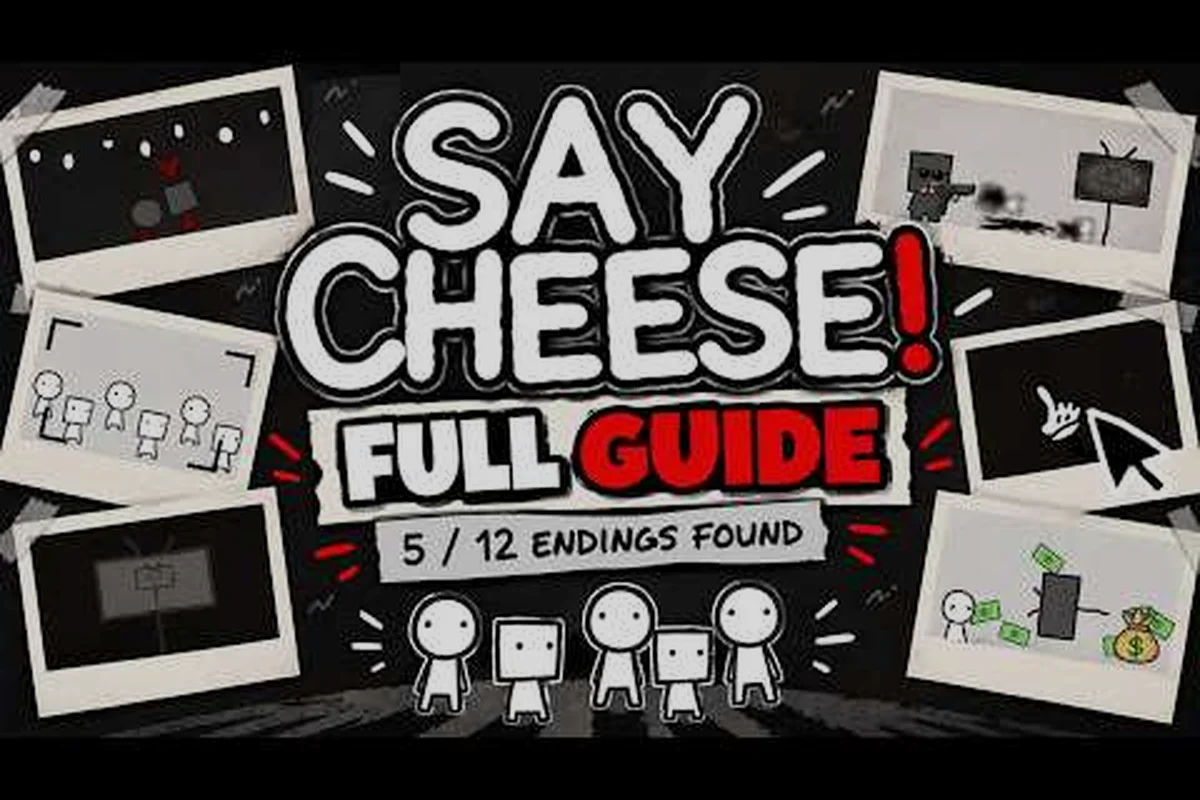
The Say Cheese Roblox chaos ending matters because the game frames the result through the choices that create disorder, not through a creator-published title. Learn what the official text establishes, how escalation works, and how to record the final decision without inventing a name.
Chaos and Panic in the Official Text
The official Roblox page gives the clearest evidence for the Say Cheese Roblox chaos ending. It places the player in the role of a journalist working for “Big Media,” sends that character to a park, and states that the job involves spreading chaos and panic while an enormous audience watches the resulting news. That premise establishes a deliberate escalation from individual reporting to public disorder.
The creator also connects the premise to the camera and news imagery in the title. The opening line tells the player that the journalist is on camera, while the larger framing asks what happens when media attention amplifies collective behavior. These details make the chaos path feel less like a combat route and more like a narrative experiment about attention, emotion, and responsibility. Several claims are safe because they come directly from the official listing for Say Cheese! on Roblox. Others require caution because the public page does not document the full sequence of events or any formal ending labels.
What the Official Description Actually Establishes
| Textual evidence | Meaning | Limit |
|---|---|---|
| The player works for “Big Media” | Journalism and spectacle are central to the premise | The page does not document every news-related interaction |
| The setting is a park | Disorder unfolds in a public environment | The page does not identify a numbered stage or area |
| The assignment is to spread chaos and panic | Escalation serves the journalist’s assignment | The page does not list every decision in order |
| Billions are expected to watch | Public attention magnifies the journalist’s actions | The number is fictional framing, not a platform statistic |
| The final framing opposes destruction with hope | The central decision has two broad moral directions | The creator has not published formal labels for the results |
This table separates a documented premise from an invented walkthrough. The official page establishes the objective and the final moral conflict, but it does not provide a complete transcript of the choices. Any detailed route description should therefore be framed as an observation from a particular playthrough rather than as a universal requirement.
Why “Chaos Ending” Is a Description, Not an Official Label
The phrase “chaos ending” is useful because it accurately summarizes the objective of spreading chaos and panic. It does not, however, appear to be a creator-published ending title. The official wording supports the direction of that route but does not formally name its result.
That distinction matters for searches concerning the Say Cheese Roblox chaos ending. Players often compare routes using memorable labels, yet a community label cannot become an official fact simply because many players repeat it. The responsible approach is to describe what happened: public disorder, escalating panic, or a conclusion that follows the destructive side of the final choice.
The same discipline applies to related concepts. A community may use the Say Cheese Roblox destroy ending or Say Cheese Roblox save ending as shorthand. Until the creator publishes names, it is clearer to say that a route destroys the peaceful society or attempts to change fate and bring hope.
How Satire Uses Escalation
Satire becomes visible through the accumulation of consequences, not through a single cinematic reveal. The game begins with a journalist, a camera, and a mission to generate alarming news. Each apparent success may then increase visibility, social reaction, or the scale of disorder. The official description supports this thematic reading, although the exact number and arrangement of interactions are not documented.
This escalation makes the Say Cheese Roblox last decision more meaningful. A route that has consistently amplified chaos reaches the final conflict from a different position than one that resisted it. The player is not merely selecting between abstract labels; the selection closes a chain of actions and their public consequences.
Escalation as a Narrative Pattern
A useful escalation pattern has three stages: the journalist’s assignment establishes the official duty, public amplification turns that duty into a spectacle, and the final reckoning tests whether to preserve, expose, or exploit the attention generated by the park. For the Say Cheese! Roblox chaos ending, this sequence matters because choosing to destroy or save the chaotic event is not merely an action preference; it is a response to who controls the journalist’s reporting and what consequences the broadcast creates for the park’s residents.
| Stage | Player-facing pattern | Thematic question | Evidence status |
|---|---|---|---|
| Initial assignment | The journalist is expected to produce news from the park | What does the job require? | Officially documented |
| Public amplification | Panic becomes content for a massive audience | Who benefits from attention? | Thematic reading based on the official premise |
| Final reckoning | The choice opposes destruction with hope | What should the journalist do with that power? | Officially documented |
This framework does not claim that the game uses a fixed number of rounds or that every choice has only two answers. Instead, it gives players a method for interpreting what they see. A decision becomes more chaotic when it increases attention, fuels fear, or turns private behavior into public spectacle.
The creator notes that the experience is inspired by We Become What We Behold. That reference is relevant only at the broad level of media amplifying group emotion; it does not establish that Say Cheese! reproduces the original game’s mechanics, structure, or conclusions. Any route-specific explanation must come from Say Cheese! itself.
Why Escalation Is More Useful Than an Invented Checklist
A fixed checklist would be misleading because the official page does not document every branch or the order in which they occur. Observing changes in tone, audience reaction, and the journalist’s behavior is more dependable, even though it leaves room for individual interpretation.
When a playthrough seems increasingly frantic, ask three questions about the selected dialogue choice and the resulting scene: does it validate or reject the journalist’s current behavior, does the audience respond with fear, anger, or confusion, and does the peaceful society begin treating escalation as normal? Comparing these signals helps distinguish the Chaos ending from the Hope, Destroy, and Save routes without assuming that one isolated prompt is the final decision or that the order of choices is fixed.
-
Does the selected response encourage panic, public hostility, or disorder?
-
Does the scene place more attention on the journalist’s actions?
-
Does the narrative make destruction of the peaceful society appear easier or more acceptable?
The answers create evidence without claiming that the player has discovered a secret trigger or a canonical route. For more help with comparing decisions, the reference on different choice-driven outcomes in Say Cheese! explains why observed differences should be separated from unconfirmed community labels.
Recognising When a Run Turns Chaotic
A chaotic run is recognizable through its repeated effects, not through a single alarmist scene. The central sign is that the player repeatedly advances the media objective of spreading panic. As the atmosphere intensifies, the social environment becomes less stable, and the player’s role as journalist increasingly dominates the story’s moral direction.
This recognition is essential when someone asks about the Say Cheese Roblox final choice. The last decision may express the outcome of earlier choices, but the official page does not say that one selection mechanically overrides all prior actions. It presents a moral fork: destroy a peaceful society, or alter the course of events so that hope can reach everyone. The earlier pattern still matters for interpretation.
Signals to Watch During a Run
Use the observation log below after the fact to compare the run’s visible progression across the broadcast, the final choice, and the surrounding scene. Focus on changes in panic, media attention, destructive framing, hope, and narrative pressure rather than assigning an undocumented label: the same “chaos ending” route name may describe very different runs. If the evidence is ambiguous, recheck the relevant in-game sequence instead of treating a community label as confirmation.
| Signal | What to note | Why |
|---|---|---|
| Rising panic | Whether fear becomes louder or more prominent | Panic is explicitly part of the assigned chaos |
| Wider attention | Whether more people appear to react to the broadcast | Media amplification is central to the premise |
| Destructive framing | Whether choices make harm feel justified or ordinary | The final conflict explicitly includes destroying society |
| Reduced hope | Whether hopeful language or imagery becomes less prominent | Hope is the alternative in the official framing |
| Convergent pressure | Whether the narrative increasingly pushes one conclusion | Convergence can make the final decision feel foreshadowed |
The log should not be used to declare a formula that the creator never published. Instead, it helps distinguish a run that escalated toward disorder from one that consistently rejected it. When uncertain, check in game and compare the surrounding scene with the official framing rather than relying on a community route label.
Separating “Destroy,” “Save,” and “Hope”
Three related ideas can easily be blended together. Destruction means allowing the peaceful society to be ruined. Saving means protecting that society from the consequences of the journalist’s actions. Bringing hope means changing the underlying direction of events rather than merely preventing one immediate failure.
The creator’s description supports this distinction because it frames the alternatives as destroying a peaceful society or changing fate to bring hope. It does not say that these terms are interchangeable. Consequently, a search for the Say Cheese Roblox save ending should not be answered by claiming that every hopeful result is identical to every protective result.
| Approach | Primary focus | Better description |
|---|---|---|
| Destructive route | Destruction of the peaceful society | Escalation toward public disorder and destruction |
| Protective route | Preventing the journalist’s worst effect | Efforts to preserve the society |
| Hopeful route | Changing the larger course of events | Bringing hope to everyone |
| Mixed run | Decisions alternate between directions | Record the sequence rather than assigning a certainty |
Documenting a Chaos Run
Accurate documentation matters because it creates a record that can be checked later without pretending the player saw something the official page omits. A good chaos-run record captures the observable chain from assignment to final decision, identifies the point where panic became central, and preserves uncertainty where in-game wording remains unclear.
A decision trace should record what the player chose, what changed immediately afterward, and how the journalist was presented. If a subtitle or reaction is unclear, write down only what is visible and avoid treating a player's interpretation as the creator's wording. This method is especially useful for the Say Cheese Roblox hope ending because hope can emerge gradually rather than through one obvious moment.
A Four-Step Recording Method
Step 1: Record the visible prompt. Copy only the short wording shown in the game, including whether it frames an action as destructive, protective, or hopeful. Long quotations from the official description are unnecessary because the new-player reference can help with unfamiliar interface language.
Step 2: Describe the immediate response. Compare what happens directly after the recorded Say Cheese prompt with the run’s earlier mood: did the chaos ending escalate panic, force the journalist to isolate themselves, or turn the event into broader public attention? Check repeated results across separate runs instead of assuming one choice always causes one outcome.
Step 3: Mark the turning point. Identify the first decision that clearly pushed the run away from the hope ending, then compare the chaos ending’s outcome with the save ending to see whether later choices reinforced or complicated that direction. For example, if a destructive prompt triggers the journalist’s isolation, note whether a later choice turns that private crisis into public attention or redirects the run toward the destroy ending.
Step 4: Preserve the last decision. Record the prompt and conclusion without assigning a formal title. This becomes the safest basis for discussing the Say Cheese Roblox final choice. Include the exact option text, the journalist’s final action, and the resulting ending state—such as chaos, hope, destroy, or save—because the wording of the last choice matters more than any temporary mood shift. If you cannot verify one outcome after repeated runs, label the result uncertain rather than presenting a single Say Cheese final choice as universal.
Example of a Neutral Run Log
| Moment | Observation | Interpretation |
|---|---|---|
| Opening assignment | The journalist is expected to create alarming news | The run begins inside the media premise |
| Early choice | Panic becomes more prominent after the selected action | The choice appears to reinforce the assigned objective |
| Middle shift | Public reaction becomes louder and less controlled | Escalation is now visible |
| Late choice | The journalist can preserve stability or push toward destruction | The moral conflict becomes explicit |
| Conclusion | The run closes in the direction supported by the destructive framing | Describe the outcome, but do not attach an official title |
This neutral format keeps observation separate from interpretation in the Say Cheese Roblox Chaos Ending run log, recording events such as the opening assignment, early choice, middle shift, late choice, and conclusion without assigning an official ending label. Its value is comparative: the same rows can later be checked against the Hope Ending or Destroy Ending route, where the final choice produces a different outcome. Separating what visibly happens from what the player infers also prevents a plausible Chaos sequence—especially the escalation of public reaction—from being mistaken for a fabricated game requirement.
Chaos Is a Direction, Not a Named Ending
The strongest conclusion supported by public evidence is that chaos is a direction in Say Cheese!. The official page describes a journalist who spreads chaos and panic, then frames the final choice around destroying a peaceful society or changing fate to bring hope. It does not publish a formal list, count, or set of ending names.
Community videos (as of 2026-10-31) discuss multiple endings; the creator has not published a list, a count or any ending names, so treat them as unconfirmed. This does not make personal observations worthless. It means the correct level of certainty matters: an in-game result can be reported clearly, while a community label should remain attributed as a community label rather than presented as canonical wording.
What Can Be Said With Confidence
| Tempting name | Why avoid it | Write instead |
|---|---|---|
| “The official chaos ending” | The public page does not publish that label | “A run that escalates toward chaos and panic” |
| “The save ending” | “Save” may combine different protective outcomes | “A conclusion that preserves the peaceful society” |
| “The hope ending” | Hope may be community shorthand | “A route that changes fate to bring hope” |
| “The final ending” | The game’s premise does not establish that framing | “The concluding decision” |
| “The canon route” | The creator has not published a canonical route list | “A route observed in a playthrough” |
The caution is especially important for the Say Cheese Roblox destroy ending and Say Cheese Roblox hope ending. Both phrases can help organize search results, but the body should distinguish official wording from shorthand. Searchers then receive a clearer account without being misled by labels that the creator never used.
Reading the Final Decision Without Overclaiming
The final choice should be understood as the closing expression of the chosen direction. If a run escalated through panic and destructive framing, describe the conclusion as aligning with the destructive side. If the player repeatedly resisted that escalation, describe how the game presents the effort to preserve or redirect events.
Do not claim that one earlier response is guaranteed to force a particular result, because that requirement is not documented. The official framing supports a broad contrast, not a complete route matrix. A careful answer to a question about the Say Cheese Roblox last decision should therefore identify the choices made, the atmosphere preceding the decision, and the conclusion shown in game.
Community videos can demonstrate that other players have observed different routes, but they are not substitutes for creator documentation. For a broader look at route differences, compare the choice and outcome overview with your own notes and prioritize in-game evidence whenever the two conflict.
Practical Checklist for Identifying the Chaos Route
A player does not need an invented secret condition to understand the destructive path. They need to observe whether their choices consistently feed the documented elements of chaos: panic, destructive framing, and growing public spectacle. The final selection then determines whether the story closes with society damaged or redirected toward hope.
The checklist is descriptive because it identifies patterns in a completed run instead of claiming that one fixed sequence always produces the Say Cheese Roblox chaos ending. Compare the journalist’s final decision with earlier choices: repeated panic responses, normalized destruction, a widening audience, and fading hope imagery provide more evidence than the ending label alone. This distinction matters because a dramatic finale can resemble the destroy ending without proving that the entire route was consistently chaotic.
-
Did the journalist repeatedly choose responses associated with panic or disorder?
-
Did the surrounding scene make destructive behavior appear increasingly normal or acceptable?
-
Did audience attention expand as the journalist continued acting?
-
Did hopeful imagery or language decline near the later decisions?
-
Did the concluding choice visibly align with the destructive side of the official conflict?
If most answers are yes, the run can accurately be called chaotic in direction. If the evidence is mixed, preserve the ambiguity in the log. A decision-by-decision route reference may help organize the sequence, but it should still be checked against what the current game displays.
Frequently Asked Questions
Is “Say Cheese Roblox chaos ending” an official ending name?
The public Roblox page does not present that phrase as a formal ending title. It does document a journalist assigned to spread chaos and panic, so “chaos ending” works as a descriptive label for a route that follows that direction. Treat any specific community name as unconfirmed unless the creator later publishes it.
Does the game have a separate hope ending?
Community videos (as of 2026-10-31) discuss multiple endings; the creator has not published a list, a count or any ending names, so treat them as unconfirmed. The official page clearly includes bringing hope as one side of the final conflict, but it does not confirm a separately named hope route.
How can I recognize the Say Cheese Roblox destroy ending without a guide?
Focus on the cumulative pattern: escalating panic, destructive framing, and a conclusion that appears to align with ruining the peaceful society. The official page supports this direction, but it does not document a universal choice-by-choice formula. Check in game and record the final prompt and visible outcome.
Does one choice determine the Say Cheese Roblox final choice?
The official description presents a binary moral conflict between destruction and changing fate to bring hope, but it does not document every prerequisite or state that one selection overrides the whole run. Your earlier choices still shape the context, so record the sequence and interpret the concluding scene from that evidence.
Should I use community names when documenting a Say Cheese Roblox save ending?
Community names are useful for comparing reports, but they should not be presented as official wording. Describe the action plainly as preserving the peaceful society or avoiding destructive escalation. This keeps the record useful even if community terminology changes before the creator publishes an ending list.