
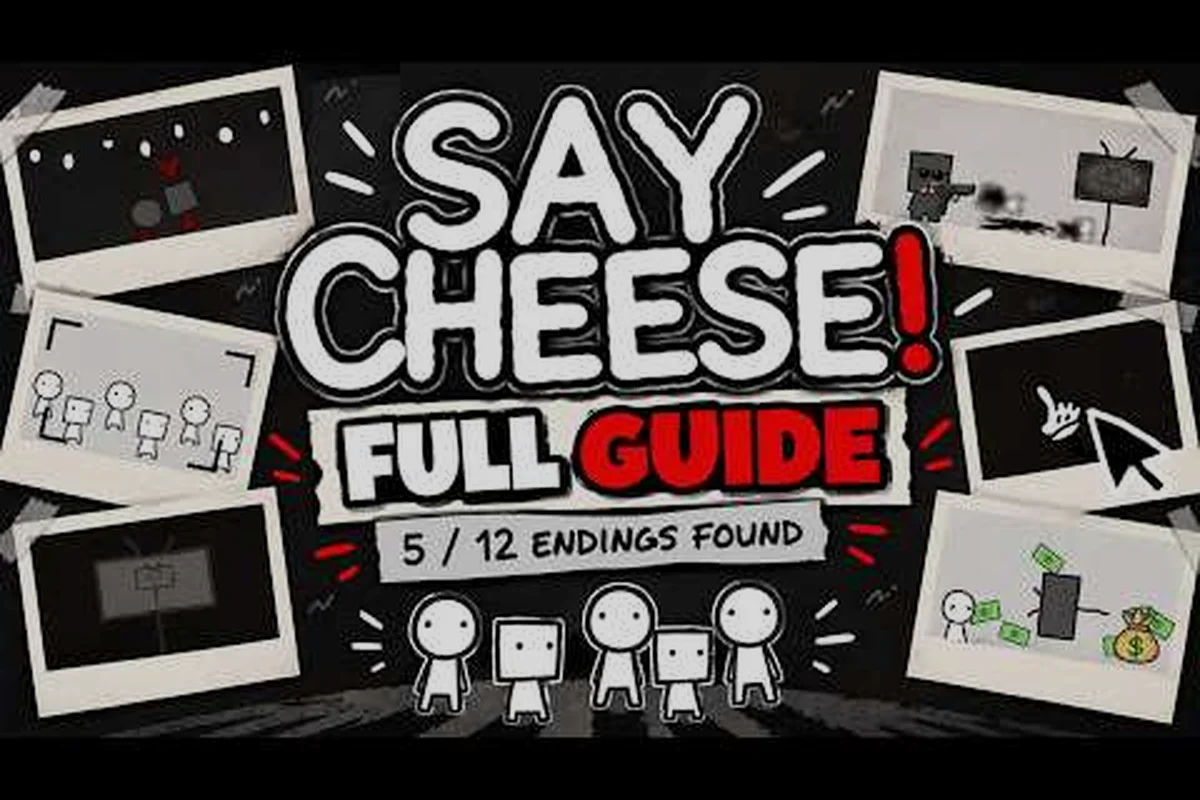
The Say Cheese Roblox ending meaning matters because the official page frames one moral choice against another: destroy a peaceful society, or change fate to bring hope. Read the documented premise closely before interpreting any ending.
Two Outcomes, One Question
The official Roblox page presents Say Cheese! as a story about a journalist hired by “Big Media” and sent to a park to create chaos while a large audience follows the news. Its central conflict is not merely whether the player succeeds, but what kind of society the player helps produce: destruction or hope. That framing makes the ending meaning a question about responsibility, spectacle, and public emotion.
The page also identifies itself as an adventure-story experience inspired by We Become What We Behold. That comparison is useful only at the thematic level of media amplifying collective emotion. It does not justify transferring plot details, character functions, or structure from the earlier work to Say Cheese! The more detailed story and theme overview can help separate the official premise from interpretation.
The documented moral binary
Only two broad outcomes are documented: destroying the peaceful society, or changing fate to bring hope to everyone. The official description closes by putting the decision in the player’s hands. This creates an unusually direct contrast because the choices concern opposite social directions rather than merely different rewards.
| Outcome | Theme | Evidence |
|---|---|---|
| Destroying the peaceful society | Chaos, exploitation, spectacle, and complicity | Explicitly described on the official Roblox page |
| Bringing hope to everyone | Renewal, responsibility, and constructive change | Explicitly described on the official Roblox page |
| A balanced middle position | Possible interpretation, not a confirmed result | Not documented; check in game |
| Any additional named outcome | Unconfirmed | Not documented; check in game |
Community videos as of 2026-10-31 discuss multiple endings; the creator has not published a list, a count or any ending names, so treat them as unconfirmed. Consequently, labels such as a happy, sad, or neutral ending can be used as analytical shorthand, but not presented as official classifications.
Why “meaning” needs evidence
The central question of Say Cheese Roblox ending analysis is not “Which outcome sounds nicest?” It is “What does the game reveal about the player’s role in public chaos?” A hopeful result can still be morally complicated if the player relies on spectacle, while a destructive result can be interpreted as a warning about what viewers and media normalize.
That distinction matters because a satisfying emotional response is not the same as a confirmed narrative label. The documented premise supports a two-direction reading, but it does not disclose exact scene changes, dialogue branches, or alternative resolutions. A responsible analysis marks those gaps instead of filling them with invented events.
Destroy the Peaceful Society as a Reading
The destructive direction is the official page’s darker mirror. The player is instructed to spread chaos and panic in a park while billions watch the latest news. That arrangement suggests that harm becomes especially dangerous when it is packaged as compelling news. The setting is ordinary and peaceful, but the media frame transforms disruption into a public spectacle.
For this Say Cheese Roblox ending discussion, the outcome should therefore be read as more than a bad result. It dramatizes what happens when a journalist treats other people’s fear as material and an audience treats distress as entertainment. The game’s title and camera imagery reinforce that interpretation, although the precise role of recording within individual scenes is not documented.
Spectacle amplifies the choice
The camera theme matters because visibility can make violence feel compelling without making it justified. The official page says that billions watch the latest news, so the audience is not a passive extra in the premise; it is part of the pressure surrounding the player’s action. The meaning emerges from the relationship among actor, event, and audience.
| Interpretive element | What the official premise supports | What remains undocumented |
|---|---|---|
| Journalist role | The player works for a media organization | Exact assignments, motives, or recurring speakers |
| Park setting | The player is sent there to cause disruption | The exact sequence of events and locations |
| Audience scale | Billions are expected to watch the news | How crowd reactions are mechanically represented |
| Camera motif | The player is explicitly on camera | The exact effect and limits of recording |
| Destructive outcome | The society can be destroyed | The scene-by-scene causes and final presentation |
This framework supports three linked interpretations. First, the destructive outcome reveals the player’s complicity: choosing to spread panic is not an accident. Second, it exposes the incentives of a media spectacle that gains attention from chaos. Third, it warns that an ordinary setting can become a site of collective harm when cameras turn disruption into the main attraction.
The strongest reading does not require claiming that every element shown in game proves the same point. It stays with the documented structure. A journalist, an audience, public fear, and a peaceful society placed at risk are enough to support a meaningful analysis of complicity and entertainment.
Why a destructive result need not be an endorsement
Players sometimes read a darker result as proof that the game celebrates the journalist’s power. That conclusion is too broad unless supported by additional evidence. A story can let someone enjoy the consequences of their choice while still presenting those consequences as harmful. The official description frames the task as spreading chaos, not as fulfilling a beneficial public mission.
A careful Say Cheese Roblox ending analysis therefore asks whether the game exposes, critiques, or rewards the system around the choice. The creator has not documented a definitive creator statement, so the safest conclusion is that the premise criticizes the transformation of chaos into a desirable spectacle. Any more precise claim about what the player is rewarded for should be checked in game.
Bring Hope to Everyone as a Reading
The hopeful direction offers a deliberate counterweight. Instead of treating panic as the product that will hold the public’s attention, the player changes fate and brings hope. The phrase “bring hope to everyone” is broad, but its placement matters: hope is presented as a collective condition rather than a private benefit for the journalist.
This direction can be understood as an ethical answer to the same media system introduced at the start. The camera remains present, but the content being broadcast changes. That contrast allows a hopeful ending to mean more than a positive mood; it can represent a choice about what deserves public attention.
Renewal still involves responsibility
Calling this route a happy ending can be useful, but that phrase alone explains too little. The emotional appeal lies in its refusal to let chaos become inevitable. If one person can redirect the event, then the journalist’s earlier decisions may have helped shape what direction the audience receives.
| Interpretive element | Hopeful reading | Caution |
|---|---|---|
| Hope | A collective shift away from panic and destruction | The exact visual presentation is not documented |
| Player agency | The choice matters because fate can be changed | Whether agency changes under every player action is not documented |
| Media | The same attention system can carry constructive news | The game does not publicly explain media reform |
| Moral weight | Responsibility can become constructive rather than destructive | A happy emotional response does not prove every decision was harmless |
The hopeful route therefore supports the Say Cheese Roblox happy ending interpretation while preserving nuance. It suggests that the player can exercise influence responsibly, but it does not automatically prove that the journalist’s methods or sensationalism disappear. That distinction is important because hope achieved through the same spectacle machinery may still carry ethical complications.
A broader account of the inspiration and its philosophical concerns appears in the discussion of Say Cheese! themes and inspiration. That discussion should still remain thematic, since using the earlier work to explain every scene would exceed what the official page documents.
A question of collective emotion
Both directions concern what the public is made to feel. Chaos generates fear, panic, and attention; hope creates a different collective orientation. The moral choice therefore resembles a decision about which social atmosphere journalism helps produce. That is why the outcome meaning depends less on whether the screen turns dark or bright than on the emotional pattern the game presents.
The documented evidence is strongest for the contrast itself. It is weaker for any claim about the player’s emotional state, forgiveness, public reputation, or final reaction. Those details are not documented in the research available for this article, and readers should check in game rather than treating community thumbnails or titles as a transcript.
Why Meaning Does Not Require a Canon
The Say Cheese Roblox ending meaning does not depend on receiving an official interpretation from the creator. Story endings can support multiple readings because players bring different ethical assumptions, personal experiences, and expectations about media. The official premise supplies the conflict; the player supplies the interpretive judgment.
That does not mean every interpretation is equally sound. A strong reading should distinguish three layers: documented setup, observable experience, and personal commentary. The first can be cited to the official page. The second can be described only after direct observation. The third should clearly read as interpretation.
Evidence levels for interpretation
| Lens | What it highlights | Limit |
|---|---|---|
| Ethical reading | Responsibility, complicity, and the choice to protect a peaceful society | Does not prove the creator’s personal moral position |
| Media critique | News spectacle, audience attention, and emotional amplification | Does not document the full production process |
| Political reading | Public order, collective identity, and who benefits from disruption | Exact social institutions are not documented |
| Psychological reading | Hope, fear, complicity, and moral discomfort | Player motives can vary |
| Player-response reading | How different choices shape emotional satisfaction | Community descriptions remain unconfirmed until verified directly |
This structure prevents interpretive certainty from becoming a substitute for evidence. It also explains why community labels can be useful shorthand without becoming official truth. When someone calls a result a sad ending, they may be describing its emotional impact. When they call another neutral, they may be presenting a summary judgment rather than reporting a formal classification.
The choice as the central ending
Perhaps the most defensible conclusion is that the choice itself is the story’s principal ending device. The official page frames two futures and assigns agency to the player. A fixed canonical doctrine would narrow that design, whereas the moral contrast allows each run to expose the player’s priorities. The ending becomes a mirror of decisions made under pressure, not just a final label attached to a completed route.
That interpretation also handles the fact that the creator has not published an ending list. Community videos as of 2026-10-31 discuss multiple endings; the creator has not published a list, a count or any ending names, so treat them as unconfirmed. The absence of an official taxonomy does not remove thematic meaning, but it does rule out presenting community terminology as creator canon.
The journalist’s position
The journalist role creates another layer of meaning because professional framing can normalize behavior. A person hired by a large media organization may follow instructions, chase attention, or treat a public assignment as routine. The game’s premise therefore allows readers to ask whether personal responsibility weakens when a system gives orders and rewards visibility.
This is interpretation rather than a documented inner monologue. The official page does not explain whether the journalist acts freely, under coercion, or out of ambition. Accordingly, the strongest analysis asks what the role reveals about systems of media work without claiming a motive that has not been established.
Reading Without Inventing Plot
A spoiler-conscious Say Cheese Roblox ending discussion should distinguish documented premise from community observation. The official page gives the player identity, location, assignment, audience scale, and two broad outcomes. It does not provide a scene-by-scene breakdown of either route. That boundary is essential because a thematic reading can be deep without pretending to know exact plot details.
Spoiler-safe discussion guide
| Question | Safe to ask | Why |
|---|---|---|
| What does the player do for a living? | Can the player be identified as a journalist? | Yes; this is part of the official premise |
| Where does the assignment happen? | Can the park setting be named? | Yes; it is documented on the official page |
| Who is meant to watch? | Can the large news audience be discussed? | Yes; the premise explicitly mentions billions watching |
| What broad futures can the player choose between? | Can destruction and hope be contrasted? | Yes; both are officially described |
| What exactly happens in the final scene? | Can specific visuals or dialogue be quoted? | Only after direct observation |
| Which outcome has an official name? | Can community labels be repeated as confirmed names? | No; the creator has not published ending names |
| Does the ending include a neutral outcome? | Can neutral be used as a personal judgment? | Yes, as analysis, but not as an official classification |
A practical rule is to write documented premise beside every concrete plot claim. “The journalist creates chaos in a park while billions watch” is documented. Any more specific sequence requires direct observation or a clearly labeled community report. This approach makes the analysis more honest and more useful to readers comparing interpretations.
Evidence labels improve the discussion
The most readable community discussion uses three levels. Official fact identifies the premise published by the creator. Direct observation records what a player experienced in game. Interpretation explains the possible emotional or social meaning. Mixing those levels without labels often turns speculation into false consensus.
The same method helps when comparing a Say Cheese Roblox sad ending with a Say Cheese Roblox neutral ending. A route can feel sad because of its subject matter or consequences, while another can feel neutral because the player sees the choice as structural rather than personal. Those are reactions, not official labels, and they remain useful when framed accurately.
For a choice-by-choice record of observable events, the companion decision-by-decision walkthrough can serve as a source of direct experience rather than as a substitute for the official page. Players should still compare it with the current game because the experience was updated on 2026-10-31.
Verify the creator before trusting fan labels
The official experience is associated with Mechanical Boy LLC and place ID 100453542816833. Its creator identity can be checked through 2stefani1's official Roblox profile page, which helps distinguish pages that use the same title from the verified project. As of 2026-10-31, the official page listed 3,955,237 visits, 49,747 favorites, and 12,154 likes versus 1,369 dislikes.
Those figures establish attention and reception, not the meaning of a particular outcome. They also show why precise terminology matters: many players may encounter different community labels for the same broad route, while the official page itself remains much more restrained about what it has documented.
A Balanced Ending-Making Framework
A balanced interpretation does not split the difference mechanically between destruction and hope. It recognizes that each direction reveals a different danger. The destructive route exposes the ease with which media spectacle can celebrate panic. The hopeful route demonstrates that attention can be redirected, while also asking whether the means of creating hope deserve scrutiny.
This framework lets readers hold contradictory observations without collapsing them into a generic verdict. A hopeful result can produce discomfort because responsibility remains visible. A destructive result can be compelling because it exposes how power, camera, and audience work together. Moral ambiguity is not an excuse to ignore the official binary; it is a way of describing the tensions inside each direction.
Compare interpretations, not labels
| Interpretation of the hopeful route | Interpretation of the destructive route | Best shared question |
|---|---|---|
| Hope demonstrates meaningful agency | Destruction demonstrates harmful agency | What does the game believe individual choices can alter? |
| The media can circulate constructive emotion | The media can amplify panic | Which emotions does public attention reward? |
| The player may be responsible for renewal | The player may be responsible for escalation | How does professional identity shape moral responsibility? |
| A positive mood may still feel uneasy | A negative mood may still feel exciting | Why can disturbing outcomes remain compelling to players? |
The table is not an attempt to establish a neutral route. It is an interpretive tool. By placing the two outcomes side by side, readers can identify the values they are rewarding or rejecting and decide whether they view hope as uncomplicated, costly, or strategically manufactured.
Three questions for your own reading
Start with Who benefits? The official premise identifies a media organization, a journalist, and an enormous audience, but it does not explicitly explain how benefits are distributed. Next ask What is visible? The camera theme makes visibility central, though the exact mechanics are not documented. Finally, consider What becomes normal? If panic becomes the news people expect, the destructive route can be read as a critique of normalization rather than merely a bad event.
These questions remain useful even if a player has not seen every scene. They connect directly to the documented premise and invite careful observation afterward. They also make the ending discussion more constructive because disagreement can focus on evidence and values rather than on labels alone.
Frequently Asked Questions
What is the Say Cheese Roblox ending meaning?
The documented ending meaning centers on a moral choice between destroying a peaceful society and changing fate to bring hope. The journalist’s assignment to spread chaos for a mass audience suggests that spectacle and personal responsibility are central. Exact scene-level meanings remain subjective and should be verified directly in game.
Is there a confirmed happy ending in Say Cheese Roblox?
A hopeful route is explicitly documented because the official page says the player can change fate to bring hope to everyone. Calling it a happy ending is reasonable shorthand, although the creator has not published official ending names. Its exact presentation and any moral complications require direct observation.
Does Say Cheese Roblox have a neutral ending?
The official page does not document a neutral outcome, and the creator has not published a list, count, or ending names. Community videos as of 2026-10-31 discuss multiple endings, so neutral may describe a player’s reaction, but it should not be presented as an official classification. Check in game for the current experience.
Why does the camera theme matter to the ending analysis?
The camera motif connects the player’s actions to public visibility, while the official premise places billions of viewers in the news audience. That relationship supports an analysis of spectacle, complicity, and emotional amplification. It does not establish every possible function of recording, so concrete mechanical claims should be checked in game.
Can different players interpret the same Say Cheese Roblox ending differently?
Yes. The two documented directions create a clear ethical contrast, but each route can support readings centered on responsibility, media incentives, collective emotion, or personal complicity. Strong discussion identifies which details are official, which were observed directly, and which claims are interpretations, allowing disagreement without presenting speculation as fact.