
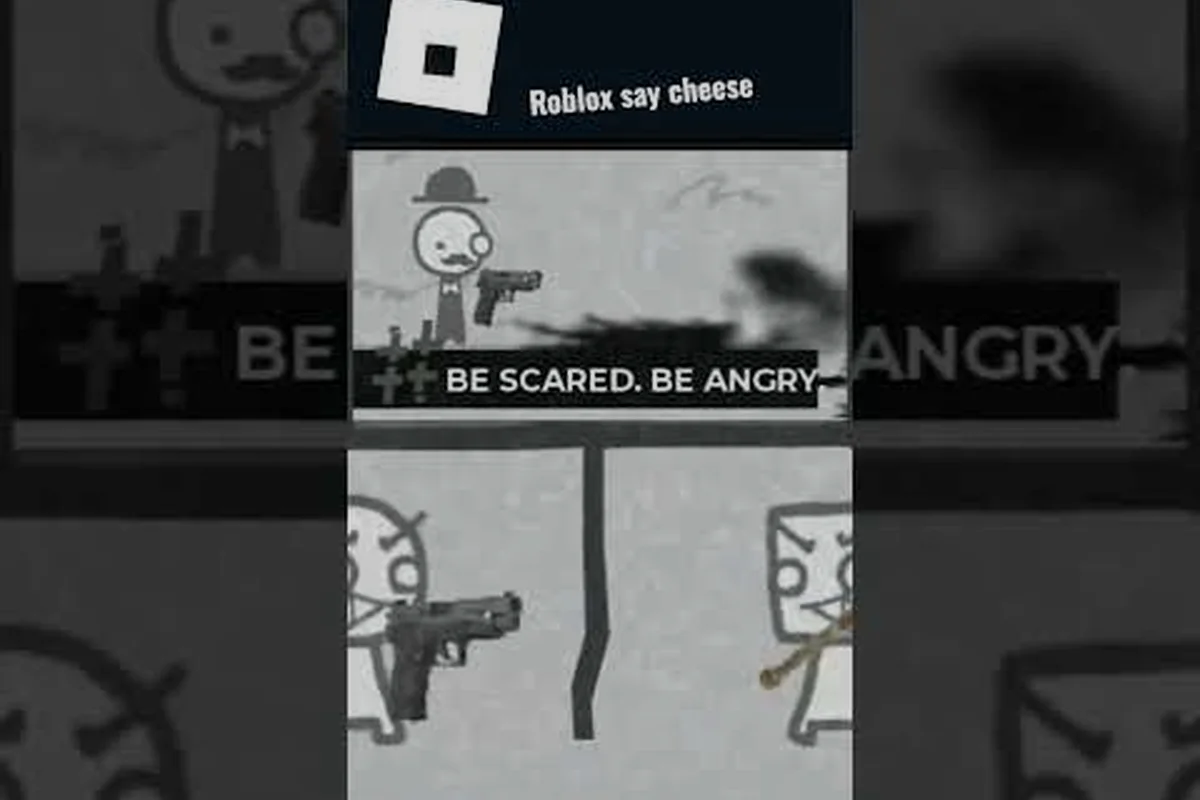
Say Cheese! Roblox inspiration matters because a credited influence shapes how players read a story without determining what actually appears in it. The official page names We Become What We Behold, but this analysis separates shared themes from the Roblox experience's own documented premise.
What the Creator Says the Inspiration Is
The creator states that Say Cheese! is based on We Become What We Behold, the browser game by Nicky Case. That statement establishes an acknowledged influence, and it is the strongest available evidence for the Say Cheese! Roblox inspiration relationship. It does not, by itself, establish that the two works share a plot, structure, cast, sequence of events, or specific dramatic beats.
The official Roblox listing describes the player as a journalist working for “Big Media.” The character is sent into a park with instructions to create disorder and panic while a vast audience follows the news. The central choice is framed between destroying a peaceful society and changing its fate in a hopeful direction. The camera motif introduced by the title makes the journalism premise visually and thematically coherent.
This summary should be read carefully. The official page does not document a detailed sequence for the story, so a more granular account of its narrative progression would go beyond the available evidence. Any analysis that assigns specific events, characters, or outcomes to the Roblox experience should use the labels not documented or check in game.
| Evidence | What it establishes | What it does not establish |
|---|---|---|
| Official “based on” statement | The creator openly acknowledges an inspiration | That the experience is a direct adaptation |
| Journalist employed by Big Media | A media-centered professional role | How every interaction unfolds |
| Park assignment | A public setting connected to panic and spectacle | A named location or a fixed route |
| Choice between destruction and hope | A broad moral framing | A complete map of every possible decision |
| “You’re on camera!” | A camera and audience motif | The existence of any named photograph or action |
The relevant record is more limited than many early reviews make it seem. The creator released the experience on October 19, 2026, and the official listing was updated on October 31. The public page listed 3,955,237 visits, 13,403 players, and 49,747 favorites as of 2026-10-31. Those figures show public interest, but they say nothing about whether the story copies another work.
Evidence Before Interpretation
A sound Say Cheese! Roblox story analysis begins with three layers of evidence: what the official page says, what a player can observe directly, and what community reports add. These layers should not be treated as equally reliable, because a creator's own description carries more authority than an unsourced interpretation.
The official description provides a useful thesis rather than a full plot synopsis. It establishes a journalist, a media spectacle, public fear, and a hopeful alternative. A broader overview of Say Cheese!'s documented premise can then be evaluated without importing details from the cited game.
| Claim type | Best evidence | Responsible phrasing |
|---|---|---|
| Premise or framing | Official Roblox page | “The official description presents…” |
| Personal observation | Direct play | “In the version observed…” |
| Community interpretation | Community reports (as of 2026-10-31) | “Community reports (as of 2026-10-31) describe…” |
| Unknown detail | Insufficient public documentation | “The official page does not document this; check in game.” |
This evidence hierarchy prevents a common analytical mistake: treating the inspiration credit as permission to describe every feature of one game through the other. The two works can share a concern with media influence while remaining formally and narratively distinct.
Shared Theme: Media Amplifies Group Emotion
The most defensible comparison concerns the role of media. Say Cheese! places a journalist inside a public spectacle watched by an enormous audience. Its official framing asks how news coverage can spread fear or redirect a society toward hope. That creates a clear thematic conversation about collective emotion and the pressure placed on journalists to perform for viewers.
We Become What We Behold is likewise associated with examining how media shapes the perceptions and emotions of groups. The shared ground is therefore meaningful: both works invite the audience to look at mass attention as an active force rather than a passive backdrop. This is the foundation of the Say Cheese! Roblox similar to We Become What We Behold comparison, provided the comparison stays at theme level.
| Theme | Shared | Distinct |
|---|---|---|
| Mass attention | An audience magnifies the significance of events | Say Cheese! explicitly centers a journalist and broadcast news |
| Group emotion | Fear and hope shape collective direction | The Roblox framing emphasizes panic spread through a public assignment |
| Professional agency | Media workers influence what viewers receive | The official description gives the player a destructive-or-hopeful choice |
| Public space | A setting becomes meaningful through communal reaction | Say Cheese! identifies the location as a park |
| Moral pressure | The worker must decide what to do with influence | The exact moral test is not documented beyond the premise |
A thematic resemblance does not require identical execution. One work may explore its subject through many intimate conversations while another stages it as an interactive Roblox narrative, but the supplied evidence supports only Say Cheese!'s broad premise. It does not establish a detailed sequence of conversations, scenes, or presentation techniques.
The Moral Is Not an Exact Message
Say Cheese! Roblox moral questions should therefore be framed as questions rather than declarations. The official binary—destroy a peaceful society or bring hope—suggests a conflict between harm and constructive change. Yet that framing does not tell us whether the story endorses one role, critiques both institutions and individuals, or exposes a trap in which the journalist believes agency exists but merely performs a script.
The safest conclusion is that the experience places media workers in a moral position where audience attention becomes consequential. Whether that position is ironic, tragic, or ambiguous is not documented on the public page. A player's direct experience may support a more specific reading, but the evidence should remain distinguishable from the creator's own framing.
| Interpretation | What supports it | What remains uncertain |
|---|---|---|
| Journalism can weaponize fear | The journalist is told to create chaos and panic | How the game dramatizes that process |
| Broadcasts shape collective behavior | Billions are said to watch the latest news | The precise causal presentation |
| Hope is another possible spectacle | The choice offers hope as an alternative | Whether hope is sincere, manipulative, or compromised |
| Media workers bear responsibility | The player receives an assignment and a consequential choice | Whether individual or institutional responsibility dominates |
This approach also explains why the Say Cheese! Roblox philosophy cannot be reduced to a single slogan. A moral question and a philosophy are not identical. The moral asks what the player should do; the philosophy asks what media, crowds, responsibility, and hope mean within the narrative framework.
Why Inspiration Is Not a Content Source
An inspiration credit answers a genealogical question: where did the creator find ideas, questions, or design principles? It does not transfer every asset, event, and implication from the earlier work into the Roblox experience. This distinction matters because a source work can influence tone or premise while the new work develops its own scenes and consequences.
The comparison with the original should therefore use the background on We Become What We Behold to understand the cited work, not to fill gaps in Say Cheese!'s story. The original game's own design, sequence, characters, and outcomes cannot be used as facts about Say Cheese!, because they are not documented on the Roblox page.
| Claim boundaries | Allowed | Forbidden |
|---|---|---|
| Inspiration | “The creator says the experience is based on We Become What We Behold.” | “It reproduces the original story.” |
| Media theme | “Both works foreground media and group emotion.” | “Both use the same scenes or sequence.” |
| Roblox premise | “A journalist is sent to spread panic in a park.” | “The player follows the original game's protagonist.” |
| Choice | “The official framing contrasts destruction with hope.” | “Every ending in the Roblox game mirrors the original.” |
| Unknown material | “That detail is not documented; check in game.” | “The Roblox version includes the original characters.” |
Citation Etiquette in Practice
Good citation etiquette means keeping the subject of every sentence clear. When discussing Say Cheese!, cite its Roblox page for its premise. When discussing We Become What We Behold, use a reliable source for the original game's own record. When making a comparison, mark the inference as a comparison rather than a shared fact.
| Situation | Correct phrasing | Incorrect phrasing |
|---|---|---|
| Discussing the Roblox premise | “The official page presents a journalist assigned to create panic.” | “The player meets the original characters while doing this.” |
| Identifying the influence | “The creator credits We Become What We Behold.” | “It is secretly a copy of the cited game.” |
| Comparing themes | “Media and collective emotion connect the works.” | “The same sequence drives both stories.” |
| Addressing missing details | “The official page does not document this; check in game.” | “Community videos prove exactly how it works.” |
| Reporting outside coverage | “Community reports (as of 2026-10-31) discuss multiple endings; the creator has not published a list, a count or any ending names, so treat them as unconfirmed.” | “The game has a specific confirmed number of endings.” |
The final row matters because outside videos can spark useful discussion without serving as a substitute for official documentation. Community videos (as of 2026-10-31) discuss multiple endings; the creator has not published a list, a count or any ending names, so treat them as unconfirmed. A careful article should mention that uncertainty without converting rumor into structure.
Avoid Reverse Engineering From a Similarity
The risk of a similarity claim is that it encourages readers to map the source game's details onto Say Cheese!. That approach can create a false history: the Roblox experience appears to repeat a famous original because every blank has been filled from elsewhere. The official evidence instead supports a narrower and more accurate claim—the creator names a media-focused predecessor as inspiration.
For readers who want to place the experience among other interactive works, the relevant comparison of Say Cheese!-like experiences should use mood, theme, and platform tags rather than assume shared narrative content. Even a title can be misleading if its visual appearance resembles another work without sharing its mechanics or moral structure.
Reading an Homage Fairly
A fair reading honors both similarity and independence. It recognizes the credited influence, explains the themes that genuinely connect the works, and resists filling undocumented gaps. The goal is not to diminish Say Cheese! by calling it derivative or to exaggerate its originality by denying a clear citation. Both habits distort interpretation.
The first step is to extract the documented premise in neutral language. The second is to identify the interpretive question raised by that premise. The third is to compare it with the source at the level the evidence supports. Finally, the reader should identify which observations came from direct play and which remain interpretive.
A Four-Part Reading Method
Start with the official statement about the journalist, park, audience, and choice. Then write a thematic claim in one sentence: media turns individual actions into collective consequences. Next, ask whether the Roblox work develops that claim through its own documented setup. Finally, mark any deeper conclusion as not documented rather than borrowing it from the source.
| Stage | Question | Example conclusion |
|---|---|---|
| Record | What does the official page establish? | The player is a journalist assigned to spread panic in a park. |
| Interpret | What ethical question does that premise raise? | When does reporting amplify harm instead of informing? |
| Compare | What can responsibly be shared? | Both works foreground media and group emotion. |
| Limit | What cannot yet be supported? | A detailed parallel between specific narrative events is not documented. |
This method also gives criticism a constructive direction. Instead of asking whether Say Cheese! is “like” another work in the loose sense of similar mood, ask whether its use of journalism, spectacle, fear, and hope produces a distinct philosophical pressure. That is a more precise standard of originality.
Evidence Labels for Deeper Interpretation
Labels are especially useful in a Say Cheese! Roblox hidden meaning analysis because a hidden meaning is interpretive by definition. The official premise can establish what the player encounters, while direct observation can establish what those encounters suggest. Community reports can add hypotheses, but they should remain marked as such.
| Statement type | Preferred label | Reason |
|---|---|---|
| Creator-stated premise | Official page | Directly attributable |
| Observed player experience | Check in game | Requires firsthand verification |
| Community interpretation | Community reports (as of 2026-10-31) | Useful but not creator-confirmed |
| Unspecified plot fact | Not documented | No basis for certainty |
This discipline protects readers from overclaiming while still allowing meaningful analysis. A critical essay can interpret a camera motif, a journalist's assignment, or the promise of hope without pretending those interpretations are creator statements. It can also say that the official page does not document a specific scene and invite verification through play without inserting a fabricated walkthrough.
Comparing Two Works Without Merging Them
A sound comparison gives each work its own column and recognizes what belongs to each side. Say Cheese! is documented as an Adventure/Story experience on Roblox, created by Mechanical Boy LLC and released on October 19, 2026. We Become What We Behold is a separate work by Nicky Case. Their relationship is one of acknowledged inspiration, not ownership of a shared narrative.
The comparison becomes cleaner when each column is checked against a different authority. The Roblox page supports claims about the Roblox experience, while an independent reference supports claims about the cited work. A shared column should only contain abstractions that can be defended from both sides.
Three Levels of Similarity
Theme similarity sits at the highest defensible level here. Premise similarity is more demanding because it requires matching a role, setting, conflict, and progression. Formal or structural similarity demands even more direct evidence and should not be inferred from a single premise resemblance.
| Level of comparison | Evidence needed | Say Cheese! assessment |
|---|---|---|
| Theme | A common subject or concern | Media, public attention, fear, and hope can support a careful comparison |
| Premise | Similar role, setting, and conflict | The Roblox role and setting are documented; a full match is not established |
| Structure | Comparable sequence and dramatic organization | Not documented on the official page |
| Specific content | Matching events, interactions, or outcomes | Cannot be transferred from the source work |
This framework prevents a common analytical error: treating a high-level resemblance as proof that all lower-level features must match. If two stories are about public fear and media influence, they may ask that question through entirely different means. The reader should look for evidence of those different means in the Roblox experience itself.
What the Public Record Adds—and Does Not
The public snapshot offers useful context for interest, not interpretation. As of 2026-10-31, the Roblox page showed 3,955,237 visits, 13,403 players, 49,747 favorites, and 12,154 likes alongside 1,369 dislikes. The creator group had 4,810 members. The experience was marked Minimal maturity, and the listed server capacity was 12. These are platform and popularity facts, not narrative evidence.
The official creator group listed only Say Cheese! as a public experience during the same snapshot. Its Japanese-language public description did not include a separate website, Discord invitation, YouTube channel, or published changelog. Consequently, there is limited creator-side material for tracing design development. Where the record is thin, the responsible move is to state the limitation and avoid filling it with speculation.
| Public data | Snapshot value | Analytical use |
|---|---|---|
| Visits | 3,955,237 as of 2026-10-31 | Evidence of audience reach |
| Players | 13,403 as of 2026-10-31 | Evidence of concurrent interest |
| Favorites | 49,747 as of 2026-10-31 | Evidence of saved interest |
| Likes and dislikes | 12,154 and 1,369 as of 2026-10-31 | A strongly positive reception snapshot |
| Group members | 4,810 as of 2026-10-31 | Context for the creator group |
| Server capacity | 12 as of 2026-10-31 | A capacity figure only, not a design feature |
Roblox itself is a broad platform available across devices and governed by its own account and moderation systems, as summarized on the Roblox page on Wikipedia. That platform context can explain how the experience is distributed, but it cannot establish what happens inside the story. The boundaries remain the same: distribution facts belong to the platform, premise facts belong to the official game page, and thematic judgments belong to the reader.
A Fair Conclusion
Say Cheese! deserves recognition as a work influenced by an earlier exploration of media and collective emotion. Its documented premise adds a distinct frame: a journalist deliberately tasked with spreading chaos in a park while billions watch. That premise can support a meaningful Say Cheese! Roblox moral analysis, but only when the critic keeps the evidence and interpretation separate.
The title's camera reference further clarifies the tone without proving a detailed technique. It signals a world organized around observation and display. Whether that world critiques journalism, dramatizes the ethics of attention, or reveals how a supposedly individual choice is absorbed by mass spectacle remains open to debate. The official page does not document enough detail to settle those questions conclusively.
For further visual context, the account of Say Cheese!'s minimalist visual style can help readers connect presentation choices with the documented camera-and-audience premise. That analysis still should not use the visual language of the cited game as a substitute for direct observation.
Frequently Asked Questions
What inspired Say Cheese! Roblox?
The creator says Say Cheese! is based on We Become What We Behold, the browser game by Nicky Case. That credit supports a comparison around media, group emotion, and public attention. It does not prove that the Roblox experience reproduces the original game's plot, sequence, or interactions. The official Roblox page remains the primary source for Say Cheese!'s premise.
Is Say Cheese! a direct port of We Become What We Behold?
No direct port is established by the available evidence. Say Cheese! presents its own documented premise: a journalist assigned by Big Media to spread chaos in a park while a massive audience watches, with destruction and hope contrasted as choices. Claims about specific narrative parallels remain not documented and should be checked in game rather than imported from the source work.
What is the moral of Say Cheese!?
The official framing points toward responsibility within systems of media and mass attention. A journalist's assignment makes private actions consequential for a watching public, while the alternative of hope complicates any simple distinction between useful reporting and manufactured spectacle. The exact moral conclusion depends on the player's experience and interpretation; the public description does not resolve that ambiguity.
Does We Become What We Behold explain every Say Cheese! twist?
No. An inspiration source can help readers identify a thematic conversation, but it cannot supply undocumented details about the Roblox experience. Treat statements about specific scenes, interactions, or outcomes as not documented unless verified directly or supported by the official page. This keeps a Say Cheese! Roblox story analysis focused on what the experience actually presents.
Is there a confirmed hidden meaning in Say Cheese!?
There is a documented media theme, but a definitive hidden meaning is not established on the official page. The journalist role, camera motif, public setting, and hope-versus-destruction framing support several readings about attention, responsibility, and collective emotion. Treat community interpretations as community reports (as of 2026-10-31), then verify details through direct play and the official page.