
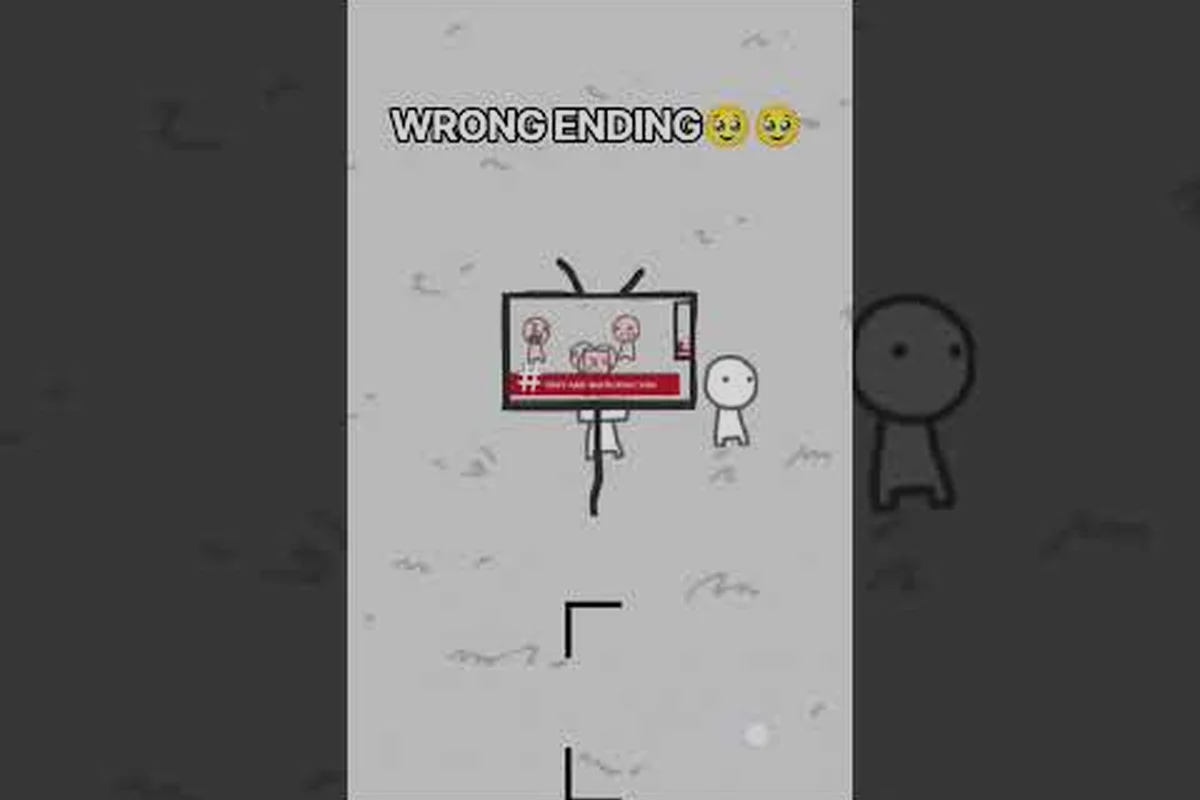
Say Cheese Roblox minimalist art makes media satire immediate: grey paper, loose black lines, and one red news bar turn the park into a camera-ready scandal. The visual style matters because it shows how attention changes public behavior; drawing on Nicky Case’s “We Become What We Behold,” each staged photo and exaggerated reaction reinforces the idea that the public spectacle creates the behavior it appears to document, while the sparse Say Cheese Roblox visual style keeps that cause-and-effect loop deliberately stark.
The Hand-Drawn Look and What It Signals
The Say Cheese Roblox visual style begins with a deliberately handmade appearance. That is not merely a decorative choice; it makes the game feel like a sketch that has started moving. The official the official Roblox listing for Say Cheese! identifies the experience as an Adventure/Story release from Mechanical Boy LLC and describes a journalist working for “Big Media.” Hand-drawn presentation fits that premise because every rough edge suggests something provisional, mediated, or unfinished.
The player is reportedly sent to a park to produce chaos while a large audience follows the news. Whether a scene feels documented or manufactured, the visible medium reminds us that somebody is framing it. A polished corporate image might make events feel authoritative. A sketch instead leaves signs of selection, emphasis, and perspective.
Rough Lines as an Editorial Choice
Loose lines have several effects. First, they soften detailed realism, which makes players concentrate on gestures, poses, and changes in the crowd. Second, they create a sense that the world exists through drawing. That is especially appropriate when the player is repeatedly placed “on camera,” as the opening presentation indicates.
The style also creates productive uncertainty. Facial details need not carry every emotion because posture and spacing can do the work. A figure leaning, recoiling, or turning away becomes readable even when the face is only a few marks. This is frame-based storytelling: meaning is assembled from the scene rather than delivered through realism.
| Visual element | Description | Effect |
|---|---|---|
| Hand-drawn outlines | Slightly irregular black contours | Makes the world feel observed and deliberately authored |
| Simplified figures | Clear poses with minimal anatomical detail | Directs attention toward behavior and group reactions |
| Sketch-like backgrounds | Loose environmental marks instead of dense textures | Supports quick visual reading and a print-like atmosphere |
| Camera framing | The scene can be presented as an image being captured | Reinforces the journalist-and-news premise |
| Visible imperfection | Uneven lines and restrained shading | Avoids the polish of conventional corporate media imagery |
Why the Style Is Not Merely Nostalgic
Calling the look “paper-like” should not reduce it to a retro costume. The official game description explicitly says the experience is based on We Become What We Behold, the browser game by Nicky Case, and that source is especially relevant to Say Cheese Roblox inspired-by questions. The shared idea is not a set of borrowed characters or situations; it is a concern with how collective emotion is shaped by what people see and share.
That distinction matters. The Say Cheese Roblox minimalist art does not need dense environmental realism to explore media influence. In fact, reduced visual density lets the social pattern remain prominent. When the environment is quiet, a sudden reaction becomes louder. When faces are spare, the body language becomes the report. When red appears only when attention matters, the player learns to associate color with urgency.
For additional context on that theme, the discussion of Say Cheese Roblox inspiration examines the official connection to Nicky Case without importing another game’s structure into this one. That distinction is important for interpreting the Say Cheese Roblox minimalist art: the resemblance is thematic rather than a claim that Say Cheese Roblox duplicates We Become What We Behold’s characters, maps, or objectives. Here, sparse scenes, restrained animation, and selective color focus direct attention toward the player’s response, so the influence is best read as a shared interest in collective emotion and media influence—not a copied game design.
Grey Paper, Black Line, White Fill
The Say Cheese Roblox color palette appears to rely on a narrow foundation: grey paper tones, black outlines, and white-filled areas. The official page does not publish a formal color specification, so exact shades and production methods are not documented. Still, the visible visual logic is clear enough to analyze without inventing technical details the creator has not confirmed.
Grey works as a neutral stage rather than a realistic environment. It can suggest paper, print, or a faded broadcast image, but its deeper benefit is that it does not compete with the action. Black lines provide structure, while white fill creates contrast and visual breathing room. Together, they produce a two-value drawing system in which shape carries most of the information.
Reading the Palette in Layers
The first layer is the grey ground. It can make every action look like a scene waiting to be reported. The second is the black line, which records boundaries and gestures. The third is white fill, which separates readable forms without requiring shading or texture. This hierarchy helps the eye understand the screen quickly, even when the subject concerns a rapidly changing crowd.
| Colour | Where it appears | Meaning |
|---|---|---|
| Grey | Backgrounds, broad surfaces, and subdued environmental areas | Creates a neutral, paper-like setting that does not compete with events |
| Black | Outlines, silhouettes, gestures, and small graphic marks | Defines forms and makes behavior legible at a glance |
| White | Selected fills and negative space | Separates figures from the ground and produces visual clarity |
| Red | The news bar or another tightly restricted accent | Marks urgency, public attention, or the intrusion of broadcast framing |
| Muted neutral colors | Secondary details where present | Supports the handmade impression without adding decorative noise |
A limited palette also standardizes attention. When everything shares the same visual range, a red rectangle becomes more than decoration. It becomes punctuation. It can announce a breaking update, separate a broadcast layer from the depicted world, or indicate that private action has become public material. Even when the exact function changes, the red remains associated with media attention.
Paper Does Not Mean Passive
Paper is often treated as a neutral or historical surface, yet this palette can imply an active process. Grey suggests a blank support waiting for marks; black records what has been noticed; white shapes remove ambiguity. That makes the Say Cheese Roblox color palette feel less like a finished photograph and more like a record constructed in front of the reader.
The official Roblox page describes the player as spreading panic while billions watch the latest news. Against that premise, the palette resembles a visual model of circulation: event, line, headline, audience. The image does not pretend to provide raw access to reality; it shows a curated representation of reality.
This is also why the art can support a paper-cutout effect even when the figures are drawn. Flat fields remove depth cues that might encourage viewers to imagine a fully modeled world. What remains is closer to a diagram of behavior. For a broader account of the setting and tone, the Say Cheese Roblox story atmosphere overview provides context that helps explain why the restrained visuals are so effective.
The Red News Bar as the Only Accent
The red news bar is the strongest focal device in the Say Cheese Roblox minimalist art. Because most of the scene stays grey, black, and white, a red band can perform several jobs at once: divide the screen, establish a broadcast frame, and signal that something has become newsworthy. Its visual authority comes from scarcity.
A Limited Graphic Element Carries More Weight
Color becomes persuasive when it is withheld. If every object were red, nothing would feel exceptional. Here, red can function like breaking-news emphasis, visually separating what happened from the wider world. This is a common media convention, but the game’s sparse design makes that convention part of the subject rather than a decorative imitation.
The bar’s rectangular shape also contrasts with organic figures. People may bend, turn, cluster, or recoil, while the bar remains mechanically aligned. That opposition creates a useful tension: lived behavior is messy, but the news frame reduces it to a clean signal. The game can therefore question the news cycle without requiring a realistic television studio.
| Function of the red accent | Visual consequence | Thematic reading |
|---|---|---|
| Draws the eye to a specific strip | Creates an immediate focal point | Directs players toward the media layer |
| Separates interface from scene | Establishes a frame around public information | Suggests that events are packaged for consumption |
| Contrasts with black and white | Makes urgency visually explicit | Associates red with urgency and amplified attention |
| Appears sparingly | Increases the perceived significance of each appearance | Teaches viewers that attention is selective |
| Uses a rigid horizontal shape | Opposes the irregularity of figures | Highlights tension between human action and editorial format |
Red as Attention, Not Just Danger
Red can conventionally signal danger, but the minimalist setting allows a broader interpretation. It can mark attention itself: the instant a private action acquires public value. The bar does not need to show a factual headline to communicate that an event has been converted into content.
This connects directly to the official premise about a journalist hired by “Big Media” and a vast audience watching the news. The red accent therefore functions like a visual thesis. It says that the most consequential feature may not be the event but the process that makes it visible. The broader philosophical reading is covered in Say Cheese Roblox’s moral and meaning analysis, while the visual evidence remains in these recurring graphic decisions.
The game’s stated inspiration is We Become What We Behold, the browser game by Nicky Case. That relationship helps explain why the media amplification motif carries so much weight, but Say Cheese! reaches it through its own hand-drawn park, camera framing, and red news treatment rather than through copied imagery. The Say Cheese Roblox we become what we behold comparison is most accurate at the level of subject: both ask what audiences do to the images they consume.
Why Minimal Art Suits Media Satire
Minimal art suits media satire because it makes the act of framing visible. Realism can make propaganda or sensationalism feel seamless; minimalist art can expose seams. By using limited shapes and a small palette, Say Cheese! keeps attention on relationships among figures, camera, news bar, and audience.
Clarity Is a Satirical Tool
Minimalism is sometimes mistaken for a shortcut, but here it serves a precise argument. A gray field offers no visual noise, and black contours let gestures carry meaning. White areas preserve separation, while red identifies the one element that demands public attention. The result is an image that can be understood quickly and revisited for implications.
| Style trait | Say Cheese! | Typical Roblox story game |
|---|---|---|
| Rendering impression | Hand-drawn, paper-like image | Often more conventionally three-dimensional or avatar-led |
| Environmental detail | Sparse marks and broad neutral surfaces | More decorative props or navigable scenery |
| Color strategy | Grey, black, white, with one red accent | Wider palette and more varied material colors |
| Character readability | Gesture, posture, and silhouette lead | Detailed models and animation often lead |
| Interface emphasis | A red news bar acts as a strong editorial layer | Menus and objectives may dominate more conventionally |
| Thematic impression | Every frame resembles something being reported | Presentation may prioritize exploration, spectacle, or progression |
The comparison is deliberately broad because individual Roblox story games vary considerably. It should not be treated as a judgment on every other experience. The point is that Say Cheese! uses a notably media-literate visual grammar: viewers are encouraged to think about how an image is framed, not only what it depicts.
The Park Becomes a Stage
The official description says the action takes place in a park. A park is normally associated with openness, leisure, and ordinary social life. Within a minimalist broadcast aesthetic, however, the park becomes a stage that can be reorganized by a camera. The environment provides common space; the news frame supplies a reason to watch what happens there.
This is where the Say Cheese Roblox visual style becomes more than an aesthetic label. It supports a scenario in which actions are performed, observed, packaged, and interpreted. The audience may be represented through the premise rather than through a large visible crowd, but the imagery constantly recalls that mediation. Attention behaves like scenery even when the literal characters are not yet visible.
Restraint Creates Ethical Distance
Minimalist presentation can also create distance without becoming emotionally neutral. Restricting detail prevents the scene from feeling like ordinary naturalistic drama. It makes the action feel like an example, a scenario, or a media artifact. That slight remove is useful for satire because the player can notice the system rather than merely react to an individual scene.
The result is neither a silent lecture nor a documentary claim. It is an interactive argument carried through composition. To compare the broader mood with other experiences, games like Say Cheese on Roblox can help place the game by atmosphere while keeping every title’s own details separate.
Reading Style as Argument
Style becomes an argument when every visual decision supports the game’s central concern with media. In Say Cheese!, the camera, journalist premise, crowd, and news bar are not separate decorative features. Together they propose a chain: something happens, a camera observes, an editorial frame appears, and an audience responds.
Follow the Chain of Attention
A useful way to read the game is to track four layers of attention: the action in the park, the camera’s act of recording, the red broadcast frame, and the implied public watching. Each layer changes the meaning of the one before it. Without a camera, an action may remain ordinary. Once recorded, it becomes evidence. Once edited into a news format, it becomes a story. Once consumed by a mass audience, it may shape collective behavior.
| Layer | What the viewer notices | What it adds to the scene |
|---|---|---|
| Park action | Figures moving, turning, or reacting | The immediate event before interpretation |
| Hand-drawn form | The image looks selected and authored | A reminder that representation is constructed |
| Camera framing | The action is being captured | Private behavior gains potential public value |
| Red news bar | A broadcast structure intrudes on the scene | The event becomes packaged information |
| Implied audience | The official premise confirms mass viewing | Individual choices acquire collective consequences |
This framework explains why even modest interface graphics can carry substantial thematic weight. The red news bar does not merely announce information; it turns the park into material for circulation, routing a hand-drawn action through a broadcast format that resembles Nicky Case’s We Become What We Behold. Because the minimalist art strips away distracting detail, the frame, camera view, and implied audience become the primary storytelling devices. In Say Cheese! terms, the result is a compact chain of attention: a player action is recorded, reframed as a news event, and presented for a public that can influence what happens next.
What the Line Quality Communicates
Black outlines are not a realistic rendering of edges; they are editorial marks. Their unevenness can imply selection, because no hand-drawn line is perfectly neutral. The style also leaves room for the viewer to notice construction. Instead of seeing only a person, the player sees a person being represented by a line on a grey field.
That double awareness supports the Say Cheese Roblox Nicky Case connection at a conceptual level. The experience is not documented as a mechanical adaptation of Nicky Case’s work. Its official attribution points to shared inspiration around what people become after consuming media. Here, that concern appears in the mark-making process itself: the world is visibly drawn, framed, and colored according to editorial priority.
A Practical Method for Reading the Art
Readers can apply a simple visual-reading method to Say Cheese! without creator commentary that the official page does not provide: compare the game’s minimalist Roblox scenes with We Become What We Behold, then treat color, spacing, composition, and figure placement as evidence of possible social meaning rather than confirmed intent. This approach suits Say Cheese’s recognizable art style because its simplified characters and limited visual cues make changes in emphasis easier to trace across individual encounters.
-
Identify which object receives red emphasis and question why it has been prioritized.
-
Note how much space surrounds the figures, because empty grey space can make social events feel exposed and easier to frame.
-
Watch whether the composition is stable or increasingly crowded, since changes in spacing can communicate collective pressure.
-
Compare the emotional tone of a scene with the tone of its news presentation, because a mismatch may expose sensationalism or manipulation.
-
Separate what happens from how it is shown, because the second question is central to the game’s visual argument.
The official page does not document a formal color guide, production pipeline, or artist interview. Those implementation details remain not documented. The observable design can still be discussed responsibly as a visual system, while exact intentions should be framed as interpretation rather than confirmed creator commentary.
From Decoration to Direction
The strongest part of Say Cheese Roblox minimalist art is its consistency. Paper tones establish a limited field, black lines explain movement, white fill separates forms, and red punctuates the public frame. Each component has a job, so the style does not feel like a filter applied to an unrelated scene. It functions as direction.
That distinction explains why the game’s visual language suits its satire. A crowded spectacle could make panic more dramatic, but it could also let spectacle become the message. Minimalism instead reveals a smaller and more disturbing proposition: ordinary behavior becomes consequential when a camera turns it into news and a large audience treats that news as a reason to react.
The Visual Language Behind the Satire
Say Cheese Roblox minimalist art works because it treats media framing as a visible structure rather than an invisible feature. The hand-drawn line shows that reality is being represented. The grey-and-white foundation removes decorative competition. The red news bar marks public urgency, while the camera premise explains why anyone would frame the park in the first place.
The Say Cheese Roblox color palette is therefore more than a list of surface colors. Grey establishes the world, black records action, white clarifies form, and red controls attention. Together, they support the official Nicky Case inspiration by making media influence legible without borrowing another work’s specific content.
The practical takeaway is to track not only the player’s action but also the instant it enters a framed shot. For example, when the red news bar appears and the camera isolates a character, the composition reveals which behavior the game wants viewers to treat as urgent or comic. That visible conversion from play to broadcast makes the Say Cheese Roblox visual style function as satire: its minimalist art does not merely depict the park, but exposes how selective framing can manufacture a public event from ordinary gameplay.
Frequently Asked Questions
Why does Say Cheese Roblox minimalist art use so few colors?
The restricted palette keeps attention on behavior instead of decorative detail. Grey provides a neutral ground, black outlines clarify movement, white separates forms, and red reserves emphasis for the news layer. This contrast makes the transition from an ordinary event to public attention visually immediate.
What does the red news bar represent in Say Cheese Roblox?
The red bar represents the media frame placed over the action. Its rigid rectangle contrasts with hand-drawn figures, while its scarcity gives it strong visual authority. It suggests that an event has acquired public importance and has been packaged for a mass audience.
Is Say Cheese Roblox directly based on We Become What We Behold?
The official Roblox page says the game is based on We Become What We Behold, the browser game by Nicky Case. The safest interpretation concerns the shared theme of media shaping collective emotion. The official page does not document a direct transfer of another game’s characters, sequences, or structure into Say Cheese!.
How does the hand-drawn visual style affect the story?
The hand-drawn style makes the world feel like a constructed image rather than unfiltered reality. Loose lines emphasize gestures, sparse detail keeps the park readable, and visible irregularities remind the player that every scene is being selected and framed. That supports the game’s focus on journalism and public reaction.